Home
About
Search
🌐
English Română
  • Iterating objects using PHP and SPL

    Citește postarea în română

    Oct 8, 2009 Design patterns iterator PHP SPL
    Share on:

    Iterator patter is probably the most popular pattern from SPL. Is a very simple way to demonstrate the advantages of an interface and SPL.

    Motivation:
    The possibility of iterating object type structures, using functions like foreach(), var_dump(), print_r() etc.

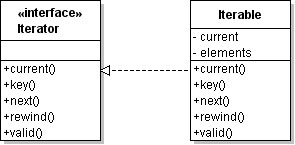
    Diagram:

    iterator diagram


    Iterator structure:

    In SPL there are a lot of interfaces and classes for iteration.

    Iterator interface base structure:

     1/**
     2 * Iterator interface from SPL
     3 */
     4Iterator extends Traversable {
     5      /**
     6       * Returns the current element
     7       */
     8      abstract public mixed current ( void )
     9
    10      /**
    11       * Returns the key of the current element
    12       */
    13      abstract public scalar key ( void )
    14
    15      /**
    16       * Moves to the next element in the array
    17       */
    18      abstract public void next ( void )
    19
    20      /**
    21       * Reset the iteration to the initial position
    22       */
    23      abstract public void rewind ( void )
    24
    25      /**
    26       * Check to see if the current position is valid
    27       */
    28      abstract public boolean valid ( void )
    29}
    

    Example 1:

    A simple iterator object.

     1/**
     2 * The class for the iterator object
     3 */
     4class Iterabil implements Iterator {
     5
     6	/**
     7	 * The index for the iterated element
     8	 */
     9	private $_current = 0;
    10
    11	/**
    12	 * Array with elements to iterate
    13	 */
    14	private $_elements = array();
    15
    16	/**
    17	 * Constructor
    18	 *
    19	 * @param array $elements Elements to iterate
    20	 */
    21	public function __construct($elements) {
    22		$this->_elements = $elements;
    23	}
    24
    25	/**
    26	 * Current element
    27	 *
    28	 * @return mixed Current element
    29	 */
    30	public function current() {
    31		return $this->_elements[$this->_current];
    32	}
    33
    34	/**
    35	 * Current index
    36	 *
    37	 * @return integer Current index
    38	 */
    39	public function key() {
    40		return $this->_current;
    41	}
    42
    43	/**
    44	 * Move to the next index
    45	 */
    46	public function next() {
    47		$this->_current++;
    48	}
    49
    50	/**
    51	 * Reset index
    52	 */
    53	public function rewind() {
    54		$this->_current = 0;
    55	}
    56
    57	/**
    58	 * Check if the current element is set
    59	 *
    60	 * @return boolean If the current element is set
    61	 */
    62	public function valid() {
    63          return isset($this->_elements[$this->_current]);
    64     }
    65}
    66
    67// class instance
    68$obj = new Iterabil(array(1, 2, 3, 4, 5));
    69
    70// iterate object
    71foreach ($obj as $value) {
    72     echo $value.PHP_EOL;
    73}
    74
    75// output:
    76// 1
    77// 2
    78// 3
    79// 4
    80// 5
    

    Example 2:

    Another example a little more complex, a class that allows to iterate through the public properties of a class which extends it. Iterator and Reflection are used.

     1/**
     2 * Class which iterates through the public properties of a class which extends it
     3 */
     4class Iterabil implements Iterator {
     5
     6     /**
     7       * The index for the iterated element
     8       */
     9     private $_current = 0;
    10
    11     /**
    12      * Array with elements to iterate
    13      */
    14     private $_elements = array();
    15
    16     /**
    17      * Current element
    18      *
    19      * @return mixed Current element
    20      */
    21     public function current() {
    22          return $this->_elements[$this->_current]->name;
    23     }
    24
    25     /**
    26      * Current index
    27      *
    28      * @return integer Current index
    29      */
    30     public function key() {
    31          return $this->_current;
    32     }
    33
    34     /**
    35      * Move to next index
    36      */
    37     public function next() {
    38          $this->_current++;
    39     }
    40
    41     /**
    42      * Reset index and get the properties
    43      */
    44     public function rewind() {
    45          // rewind is the first to be called
    46          // here the properties list should be obtained
    47          // ReflectionClass is initialized
    48          // with the current class name as a parameter
    49          $reflection = new ReflectionClass(get_class($this));
    50
    51          // we get the public properties
    52          $this->_elements = $reflection->getProperties(ReflectionMethod::IS_PUBLIC);
    53
    54          // set the current index
    55          $this->_current = 0;
    56     }
    57
    58     /**
    59      * Check if the current element is set
    60      *
    61      * @return boolean If the current element is set
    62      */
    63     public function valid() {
    64         return isset($this->_elements[$this->_current]);
    65    }
    66}
    67
    68/**
    69 * A new class with public properties
    70 *
    71 */
    72class Testing extends Iterabil {
    73     public $proprietate1;
    74     public $proprietate2;
    75}
    76
    77// class instance
    78$obj = new Testing();
    79
    80// iterate object
    81foreach ($obj as $value) {
    82     echo $value.PHP_EOL;
    83}
    84
    85// output:
    86// proprietate1
    87// proprietate2
    

    And if you what the above example to be accessible as an array you just have to implement ArrayAccess from SPL.

    ArrayAccess structure:

     1ArrayAccess   {
     2    /**
     3     * Check if the offset exists
     4     */
     5    abstract public boolean offsetExists ( string $offset );
     6
     7    /**
     8     * Returns the element of an offset or NULL if it does not exist
     9     */
    10    abstract public mixed offsetGet ( string $offset );
    11
    12    /**
    13     * Set a value for an offset
    14     */
    15    abstract public void offsetSet ( string $offset , string $value );
    16
    17    /**
    18     * Unset a value for an offset
    19     */
    20    abstract public void offsetUnset ( string $offset )
    21}
    

    Example 3:

    An even more complicated example which shows the power of interfaces from SPL. Iterator object accessible like an array.

    To simplify the array access logic I’ve used the php native functions for iterating an array (next(), reset()).

      1/**
      2 * The class for the iterator object
      3 */
      4class Iterabil implements Iterator, ArrayAccess, Countable {
      5
      6     /**
      7      * Array with elements to iterate
      8      */
      9     private $_elements = array();
     10
     11     /**
     12      * Constructor
     13      *
     14      * @param array $elements Elementele de iterat
     15      */
     16     public function __construct($elements) {
     17          $this->_elements = $elements;
     18     }
     19
     20     /**
     21      * Current element
     22      *
     23      * @return mixed Current element
     24      */
     25     public function current() {
     26          return current($this->_elements);
     27     }
     28
     29     /**
     30      * Current index
     31      *
     32      * @return integer Current index
     33      */
     34     public function key() {
     35          return key($this->_elements);
     36     }
     37
     38     /**
     39      * Move to the next index
     40      */
     41     public function next() {
     42          next($this->_elements);
     43     }
     44
     45     /**
     46      * Reset index
     47      */
     48     public function rewind() {
     49          reset($this->_elements);
     50     }
     51
     52     /**
     53      * Check if the current element is set
     54      *
     55      * @return boolean If the current element is set
     56      */
     57     public function valid() {
     58          return current($this->_elements)?true:false;
     59    }
     60    /**
     61     * Check if the offset exists
     62     *
     63     * @param string $offset Element key
     64     * @return boolean If the element is set
     65     */
     66    public function offsetExists($offset) {
     67         return isset($this->_elements[$offset]);
     68    }
     69
     70    /**
     71     * Returns the element of an offset or NULL if it does not exist
     72     *
     73     * @param string $offset Array offset
     74     * @return mixed Element or NULL
     75     */
     76    public function offsetGet($offset) {
     77         return $this->_elements[$offset];
     78    }
     79
     80    /**
     81     * Set a value for an offset
     82     *
     83     * @param string $offset Element offset
     84     * @param mixed $value Value of the element in the array
     85     */
     86    public function offsetSet($offset, $value) {
     87         $this->_elements[$offset] = $value;
     88    }
     89
     90    /**
     91     * Unset a value for an offset
     92     *
     93     * @param string $offset Element offset
     94     */
     95    public function offsetUnset($offset) {
     96         unset($this->_elements[$offset]);
     97    }
     98
     99    /**
    100     * Number of elements in the array
    101     *
    102     * @return integer Number of elements in array
    103     */
    104    public function count() {
    105         return count($this->_elements);
    106    }
    107}
    108
    109// Class instance
    110$obj = new Iterabil(array(1, 2, 3, 4, 5));
    111
    112echo 'Iteration using "for":'.PHP_EOL;
    113
    114// iterate the object like a simple array
    115for($i = 0; $i < count($obj); $i++) {
    116     echo $obj[$i].PHP_EOL;
    117}
    118
    119echo 'Element to delete: '.$obj[1].PHP_EOL;
    120
    121unset($obj[1]);
    122
    123echo 'Iteration using "foreach":'.PHP_EOL;
    124
    125// iterate the object using foreach
    126foreach ($obj as $element) {
    127     echo $element.PHP_EOL;
    128}
    129
    130// Output:
    131//Iteration using "for":
    132//1
    133//2
    134//3
    135//4
    136//5
    137//Element to delete: 2
    138//Iteration using "foreach":
    139//1
    140//3
    141//4
    142//5
    
  • Bad code and frameworks

    Citește postarea în română

    Oct 4, 2009 MySQL oop PHP
    Share on:

    Why there is so much talking about “bad code” or “bad practices”? Because they are important!
    Lately I had an unpleasant experience with uncommented code, bad design, bad implemented oop, unoptimized and badly designed  databases.

    Comments

    Is a great mystery to me how it’s possible that every book and tutorial (not just PHP) to say that comments are not optional but MANDATORY and most often there entirely missing. Zend Studio has a very simple and efficient auto-complete system, you just have to tap “/**” and press enter, and then just complete the text. Netbeans has a similar system, just as easy.

    And still, I’ve came over thousands of lines of code with almost no comments at all. The outcome? Hours and hours wasted trying to follow the logic!

    Why is this happening? First reason: is boring, a developer want’s to write code not stories, usually seems like wasted time. The second reason: everything seems very logic when it’s written, if it’s so logic and fluent why waste time with stories? Because time passes, projects change, and with time is inevitable that the logic will be forgotten. Or another reason, new employees will come, in companies developers come and go, and the new guy can’t follow the logic with the same ease, in fact it is almost impossible to follow.  Even the author of the code can’t follow the steps after a long period of time, sometimes the author was me.

    In my opinion this should be a rule of thumb for every company, no class/method/property should be left uncommented. Time spend now on commentaries is time gain later when will be done debugging,optimization etc.

    Bad design

    I’ve encounter a question on an on-line  “mini interview”: “do you see the importance of architect analysis before writing code?”, I’m sorry if the I didn’t get the exact question. The first time I’ve seen that question I had an “deja-vu” moment, a lot of the time I’ve started writing code only to realize that was the wrong approach.

    A lot of the times, the issue is solved (apparently) with time and experience. Basically, if you get a beginner to write code, most likely he will have some bad approaches before getting a good one, and this is not abnormal, that’s why I think a beginner should be guided before he will begin to write code, and the resulting code to have a suggested logic by a “mentor”.

    On the other extreme there are “software architects” which using UML they describe the logic and the structures using diagrams. When diagrams exist is much easier to follow the entire process and structure of the app. An experienced architect will be able to see the possible issues that may appear before beginning to write code, and when code is starting to be written everyone knows just what they have to do.

    OOP is probably the most affected by poor design. Lately I’ve seen a lot of classes which had no internal structure, there ware just simple wrappers for SQL queries. That’s not OOP!

    OOP is about abstracting elements in classes and objects. For instance the keyboard is a class which has keys (a child class) with various properties (letters, key code, position), some LEDs (another child class) etc. The way there organize in the database is not necessary in a tight relation with the resulting objects, as it may seem.

    If your using OOP and what you are reading now sounds weird, try drawing on a piece of paper a diagram of the objects in your app and the references between them. If you can’t, it means that your approach to the OOP is wrong (or you just don’t know to draw a diagram 🙂 )!

    We all make mistakes when it comes to OOP, but that’s not an excuse not to correct them, and to try to make architecture before code.

    A bad app design may have very important financial implications. Time is money, and if an app has poor design, is not correctly structured, the debugging time is big, changes and enhancements require a lot of time, is a lot of code redundancy, etc. , then you can be sure your losing money.

    A tool that I sometimes use is Violet UML Editor, is not a true UML editor like Rational Rose for instance, but rather an open-source toy. With Violet you can only build visual diagrams, but they can be useful to visually structure an app.

    Databases

    Why are PHP developers avoiding to truly learn MySQL? Sounds strange? Is very true though. Modifying PHP code is usually not very difficult (I mean the practical rewriting the code), but a bad database design is most of the times more difficult to change because is the risk of losing data.

    A few weeks ago I’ve made a diagram of the database using MySQL Dump and MySQL Workbench. I was quite surprise to see tables which didn’t have relation keys with the tables from which the information came from (I don’t mean settings tables or other tables which logically don’t have a relation with the other tables), then the data source was completely lost.

    Another classic problem with beginners is that when they have a relation table between two other tables, like categories and products for instance, the primary key is on a field like “id” which has no relevance. A primary key can be set on multiple fields, like for the previous example “id_category, id_product” not “id”, this way you ensure the uniqueness of a product in a category using the primary key restriction.

    Another thing that is usually avoided are the indexes. In a previous blog post I was shortly explaining them, insufficient even though there important. An index can significantly reduce the search time in a table, from tenths of a second to a thousandths of a second. A badly optimized app from this point of view can have a significant bigger response time then normal.

    Frameworks

    To quote a classical phrase in the PHP community:

    All frameworks suck.

    and Laura Thomson had some strong reasons to back this up.

    Somebody was saying last week that the reason for bad code is actually PHP and it’s loose typing. Let’s be honest, if we take in consideration a language like C++ there are a lot more issues that can arise. I remember in faculty how bad my C++ code was, and  the problem wasn’t the language but rather my skills at that time. PHP allows approaches from OOP to spaghetti code (OOP, procedural, closures, labels). The fact that many developers chose bad approaches is not a language problem, there is the same approach issue with a language like C++, or in fact with any programming language out there.

    Why are less design problems in Ruby on Rails for instance? Because is a framework! I’ve never heard of anybody doing web developing just using Ruby (there are developers out there, especially for desktop apps, but that’s another story), of course there are less issues when using a framework. The same way PHP issues can be reduced using an popular framework.

    There are tens or even hundreds of open-source PHP frameworks. Of this there are a few really popular, like Zend Framework, CakePHP, Symfony, Solar, CodeIgniter etc. An great advantage when using a popular framework is that is easy to find professionals. Another big advantage is that you have a well tested and documented code base, thing that is very hard to achieve in a small company.

    Or even if your using an in-house framework I thing is a good idea to adopt a structure of an popular framework to reduce the learning curve for new developers.

    Using an popular open-source framework usually you reduce the working time and the time to develop nu features because usually there included in the framework, so economical advantages bay arise (money), a better structure and last but not least happier developers (which I’m not at this time).

    Concluding:

    • set some rules for the code standards, don’t forget to add the comments to the list,
    • make sure the app design is according to a plan that allows for scalability and minimal code redundancy,
    • make sure the database is well structured and optimized,
    • consider an open-source popular framework over building an internal one.

    Using this simple rules will save resources, time, and probably developers will be more happy with there result.

  • PHP and Unicode using UTF-8

    Citește postarea în română

    Aug 11, 2009 PHP php6 unicode utf-8
    Share on:

    One of the biggest issues with the web is encoding.

    In the old days the formerly base standard was  ISO 8859-1, where there ware 191 latin characters defined, and 1 char = 1B. For different languages, different encodings ware used, but from here many portability issues appeared, the possibility to cover a greater number of languages etc.

    The problem occurs when a project should be available in several languages, and the number of the languages is not controlled. A big project like WordPress for example should be available with any language.

    Unicode is a better alternative for ISO 8859-1, having more then 100.000 characters defined. In other words it has about every character of about any existing language.

    As I was saying for MySQL, UTF-8 characters have a variable length between 1 and 4B.

    Displaying the UTF-8 content in PHP pages

    For browser to interpret the page content as UTF-8, it should receive the right headers:

    1<?php header("Content-type: text/html; charset=utf-8");?>
    

    Attention! The header should be the first thing that is send from the server! In other words it should be the first thing displayed on the page.

    The type of the document can be specified with the “Content-Type” meta tag. If there is a similar meta tag on the page it should be removed and replace with:

    1<meta http-equiv="Content-Type" content="text/html; charset=utf-8">
    

    The .htaccess file and string processing

    Add to the .htaccess file (for Apache servers) the following lines:

    1# default charset used by PHP
    2php_value default_charset utf-8
    3# encoding for mbstring
    4php_value mbstring.internal_encoding utf-8
    5php_value mbstring.func_overload 7
    

    The first line sets the default charset for PHP, this setting can be made directly to php.ini.

    Second and third line sets the mbstring (multi byte string) functions.

    Using UTF-8, as I was saying earlier, 1 char != 1B, so errors may appear:

    1$var = 'aşadar';
    2
    3echo strlen($var).PHP_EOL; // 7
    4echo strtoupper($var).PHP_EOL; // AşADAR
    5
    6// using mbstring functions
    7echo mb_strlen($var).PHP_EOL; // 6
    8echo mb_strtoupper($var).PHP_EOL; // AŞADAR
    

    This is why we set the mbstring functions mode using the .htaccess file. Content entered through forms should be processed using mbstring functions, to avoid problems like in the earlier example.

    The available functions are in the manual.

    Coding old content

    There are many ways to encode ISO 8859-1 content to UTF-8. A couple of ways of doing that with PHP are:

    – iconv() function which converts from a format to another specified format:

    1echo iconv("ISO-8859-1", "UTF-8", "Test");
    

    – utf8_encode() function which converts from ISO 8859-1 to UTF-8:

    1echo utf8_encode("Test");
    

    What does the future bring?

    The long-expected PHP6 will have native support for Unicode, so all the above tricks will be unnecessary. At the moment of writing this blog PHP 6 is 70.70% done, and with a little luck it will be ready in less then an year.

  • PHP observer pattern and SPL

    Citește postarea în română

    Aug 4, 2009 observer Observer pattern PHP SPL
    Share on:

    Observer pattern refers to a class called “subject” that has a list of dependents, called observers, and notifies them automatically each time an action is taking place.

    A small example of why is used:

    – let’s say we have a class with does someting:

     1class Actiune {
     2    private $val;
     3    function __construrct() {
     4        // someting in the constructor
     5    }
     6
     7    function change($val) {
     8        $this->val = $val;
     9    }
    10}
    

    Each time $val changes we want to call a method of an “observer” object:

     1class Actiune {
     2    private $val;
     3    function __construrct() {
     4         // someting in the constructor
     5    }
     6
     7    function change($val, $observator) {
     8        $this->val = $val;
     9        $observator->update($this);
    10    }
    11}
    

    Theoretically is not bad, but the more methods there are so does the dependence grows bigger and each time we add a new observer object we must modify the class, with will probably result in chaos, which will be almost impossible to port.

    Now, the observator pattern looks something like this:
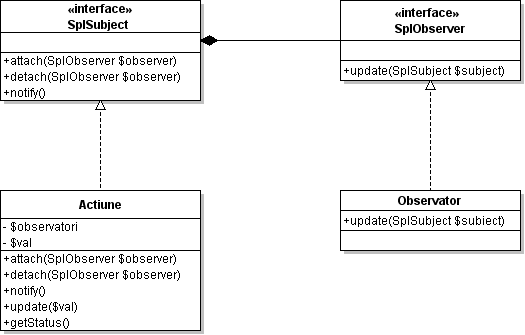
    diagrama

    SPL (Standard PHP Library), which is well known for it’s defined iterators, comes with the interfaces SplSubject and SplObserver, for the subject and respectively the observer.

    An implementation looks someting like this:

     1/**
     2 * the class which must be monitored
     3 */
     4class Actiune implements SplSubject {
     5    private $observatori = array();
     6    private $val;
     7
     8    /**
     9     * method to attach an observer
    10     *
    11     * @param SplObserver $observator
    12     */
    13    function attach(SplObserver $observator) {
    14        $this->observatori[] = $observator;
    15    }
    16
    17    /**
    18     * method to detach an observer
    19     *
    20     * @param SplObserver $observator
    21     */
    22    function detach(SplObserver $observator) {
    23        $observatori = array();
    24        foreach($this->observatori as $observatorul) {
    25            if($observatorul != $observator) $observatori[] = $observatorul;
    26        }
    27        $this->observatori = $observatori;
    28    }
    29
    30    /**
    31     * method that notifies the observer objects
    32     */
    33    function notify() {
    34        foreach($this->observatori as $observator) {
    35            $observator->update($this);
    36        }
    37    }
    38
    39    /**
    40     * method for makeing changes in the class
    41     *
    42     * @param int $val
    43     */
    44    function update($val) {
    45        echo 'updateing...';
    46        $this->val = $val;
    47        $this->notify();
    48    }
    49
    50    /**
    51     * public method with the subject's status
    52     *
    53     * @return int
    54     */
    55    function getStatus() {
    56        return $this->val;
    57    }
    58}
    59
    60/**
    61 * and observer class
    62 */
    63class Observator implements SplObserver {
    64    function update(SplSubject $subiect) {
    65        echo $subiect->getStatus();
    66    }
    67}
    68
    69// an observer instance
    70$observator = new Observator();
    71
    72// an subject instance
    73$subiect = new Actiune();
    74
    75// attaching an observer to the subject
    76$subiect->attach($observator);
    77
    78// update subject
    79$subiect->update(5);
    

    What seems strange is that there isn’t any documentation on this SPL interfaces. Even on the Zend website there is an article PHP Patterns: The Observer Pattern which does not use SPL, but for something like namespaces there was documentation even before PHP 5.3 was out.

  • PHP Romanian stemmer class

    Citește postarea în română

    Aug 1, 2009 class PHP Romanian stemmer
    Share on:

    Because I needed a Romanian stemmer at a point in time for Zend Search Lucene, and it seems that there aren’t any in PHP, I’ve made one.

    The page is here, and  comparing the resulting PHP class with a dictionary of the algorithm developed in snowball,  after which this class was made, because I tried to make class work with or without diacritics, general error has increased by about 3%,  but remaining below 5% for the whole dictionary of 22,570 words.

    As a note, the class file should be opened with an UTF-8 editor, otherwise diacritics will disappear from the file.

    Enjoy it!

    • ««
    • «
    • 4
    • 5
    • 6
    • 7
    • 8
    • »
    • »»

Claudiu Perșoiu

Programming, technology and more
Read More

Recent Posts

  • 30 years of PHP
  • HTTPS certificate monitoring in Home Assistant
  • Adding a slider to Tasmota using BerryScript
  • The future proof project
  • Docker inside wsl2
  • Moving away from Wordpress
  • Custom path for Composer cache
  • Magento2 and the ugly truth

PHP 50 MISCELLANEOUS 47 JAVASCRIPT 14 MAGENTO 7 MYSQL 7 BROWSERS 6 DESIGN PATTERNS 5 HOME AUTOMATION 3 LINUX-UNIX 2 WEB STUFF 2 GO 1

PHP 36 JAVASCRIPT 15 PHP5.3 11 MAGENTO 7 PHP6 7 MYSQL 6 PHP5.4 6 ZCE 6 CERTIFICARE 5 CERTIFICATION 5 CLOSURES 4 DESIGN PATTERNS 4 HACK 4 ANDROID 3
All tags
3D1 ADOBE AIR2 ANDROID3 ANGULAR1 ANONYMOUS FUNCTIONS3 BERRYSCRIPT1 BOOK1 BROWSER2 CARTE1 CERTIFICARE5 CERTIFICATION5 CERTIFIED1 CERTIFIED DEVELOPER1 CHALLENGE1 CHM1 CLASS1 CLI2 CLOSURES4 CODE QUALITY1 CODEIGNITER3 COFFEESCRIPT1 COLLECTIONS1 COMPOSER1 CSS1 DEBUG1 DESIGN PATTERNS4 DEVELOPER1 DEVELOPMENT TIME1 DOCKER2 DOCKER-COMPOSE1 DOUGLAS CROCKFORD2 ELEPHPANT2 FACEBOOK2 FFI1 FINALLY1 FIREFOX3 GAMES1 GENERATOR1 GO1 GOOGLE1 GOOGLE CHROME1 GOOGLE MAPS1 HACK4 HOMEASSISTANT3 HTML2 HTML HELP WORKSHOP1 HTML51 HUG1 HUGO1 INFORMATION_SCHEMA1 INI1 INTERNET EXPLORER3 IPV41 IPV61 ITERATOR2 JAVASCRIPT15 JQUERY1 LAMBDA1 LINUX1 MAGENTO7 MAGENTO22 MAP1 MINESWEEPER1 MOTIVATION1 MYSQL6 NGINX1 NODE.JS2 NOSQL1 OBSERVER3 OBSERVER PATTERN1 OOP1 OPERA1 OPTIMIZATION1 ORACLE1 PAGESPEED1 PAIR1 PARSE_INI_FILE1 PHONEGAP2 PHP36 PHP ELEPHANT2 PHP FOR ANDROID1 PHP-GTK1 PHP42 PHP53 PHP5.311 PHP5.46 PHP5.53 PHP5.61 PHP67 PHP7.41 PROGRAMMING1 REVIEW1 ROMANIAN STEMMER2 SAFARY1 SCALAR TYPE HINTING1 SCHEME1 SET1 SHOPPING CART PRICE RULE1 SINGLETON1 SOAP1 SPL2 SQLITE1 SSH1 STACK TRACE1 STDERR1 STDIN1 STDOUT1 SUN1 SYMFONY2 TASMOTA1 TEST TO SPEECH1 TITANIUM2 TRAITS1 TTS1 UBUNTU1 UNICODE2 UTF-82 VECTOR1 WEBKIT1 WINBINDER1 WINDOWS2 WORDPRESS1 WSL21 YAHOO3 YAHOO MAPS1 YAHOO OPEN HACK1 YSLOW1 YUI1 ZCE6 ZCE5.31 ZEND3 ZEND FRAMEWORK3
[A~Z][0~9]

Copyright © 2008 - 2025 CLAUDIU PERȘOIU'S BLOG. All Rights Reserved